Physical Therapy for Low Muscle Tone in Babies
- Home
- All Almost Gross Motor Skills
- An Overview of Muscle Tone
What Is Musculus Tone?

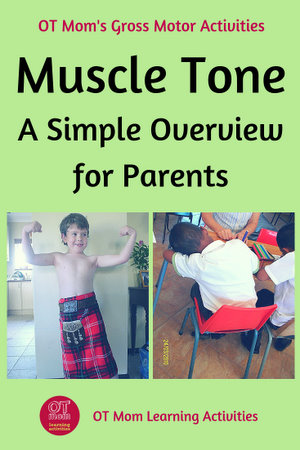
"What is low muscle tone?" is a question that parents often ask their therapist.
Many people often confuse tone with muscle strength.
Here is a simplified overview and a brief description of normal, high and low muscle tone and their effect on motility.
- Normal
- High
- Low
- The outcome of low tone on a child
- Helpful Activities
Stolov, 1966, defined the tone in the musculus as "the resistance of the muscle to passive elongation or stretching" (1).
In other words, information technology is the land of muscle tension inside a musculus or musculus group when it is at rest.
Normal Tone
Normal tone means that there is the right amount of "tension" within the muscle at residual, and that the musculus is inherently able to contract on command.
Put just, you can "tell" your muscle to cease and start and it does what you want, when you want, with the appropriate amount of force.
Here is an everyday example of how the tone in your muscles affects you when reaching for a cup of coffee!
Imagine yous are sitting in your armchair, arms resting on your lap (your arm muscles are "at rest"). Yous decide to have a sip of your coffee, which is on the table next to you lot. With your normal muscle tone, you reach out with your arm, your paw connects with your loving cup of coffee, grasps it with just the right amount of pressure, and you bring it dorsum to your oral cavity. No spills, no fuss!
Your muscles did exactly what you lot wanted them to do, at exactly the right speed, with the right amount of force, without wasting free energy or effort.
Back to Top
High Tone
High tone means there is also much tension in the muscle at balance. In other words, the muscle is tight and tense even though it is not doing anything.
A kid with spastic cognitive palsy may take high tone, which causes the arms and legs to be tightly contorted. When the arms and legs are not regularly stretched and moved through physical therapy, then "contractures" may occur, which mean less and less range of motion is possible.
Reaching for a loving cup of coffee:
In the everyday instance I gave above, if you had increased tone in your muscles, you would take to concentrate very hard and expend a lot of effort overcoming the tension in your biceps in order to stretch out your arm.
You may well end up moving your whole body towards the coffee to effort and achieve it, as the tension in your arm muscles is too loftier to be overcome with ease. Your movements are besides likely to be hasty and uncontrolled, resulting in spilled coffee.
Back to Top
Low Tone
Low tone means there is non enough tension in the muscle when information technology is at rest.
The muscle may have a slightly mushy or floppy feel to it, and there is a lack of graded control of the muscle when it is being used (graded control ways that but the right corporeality of movement and effort is used equally appropriate to the task at paw).
Reaching for a loving cup of coffee:
To use the coffee example again, when you determine yous want to have a sip of coffee, in that location is non enough tension in your muscles at rest. So you utilise a bit extra momentum, possibly by flinging your arm out!
You bump the cup a bit, go your fingers around the handle and so drag information technology back, but the cup is heavy, and you lot use too much oomph at beginning (to overcome the lack of "tension" in your muscles) with the upshot that the coffee sloshes out. Your low muscle tone resulted in clumsiness and a lack of command in doing what you wanted to do.
Dorsum to Elevation
It is of import to remember that muscle tone is on a continuum – you lot can have normal muscle tone that is a bit on the low side or a bit on the loftier side.
The Effect of Depression Muscle Tone
The tone of the muscles affects postural control and postural stability.
Postural command and postural stability give you the "groundwork" command of your body that is necessary for helping y'all to stay upright and to stabilize you during movement.
Children with low tone in their muscles may battle to sit upright for any period of time, and may slouch over similar the child in this picture.
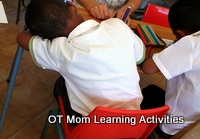
They may as well fifty ack endurance in gross and fine motor activities and they may struggle with games that require coordinated, controlled movements.
Postural stability needs to develop in 3 principal areas:
- Neck muscles
- Shoulder girdle muscles
- Core muscles (torso muscles)
If your child lacks adept postural stability, then gross motor, fine motor, and coordination skills may be affected.
Delight contact your health professional if y'all have any concerns about your kid's musculus tone, postural control or any other aspects of development. This webpage serves to inform, non to diagnose.
Helpful Activities
If yous are looking for activities to help your child develop optimally in order to be ready for schoolhouse, and so you tin can check out these pages of my site for some easy activeness ideas to strengthen your child's skills:
Thank yous for visiting!
Back to Acme
- Home
- All About Gross Motor Skills
- An Overview of Musculus Tone
Sources:
1) Mathiowetz and Haugen. Evaluation of Motor Beliefs: Traditional and Contemporary Views. Occupational Therapy for Physical Dysfunction, Baltimore: Williams & Wilkins, 1995.
If this folio was helpful, delight share it with your friends!

Didn't find what you were looking for? Try a search of my site!
If this site was helpful, please share information technology!

Source: https://www.ot-mom-learning-activities.com/muscle-tone.html
Postar um comentário for "Physical Therapy for Low Muscle Tone in Babies"